
603 hunt

The American Revolution
and the Quakers of Brentwood

The experience of New Hampshire Quakers during the American Revolution was often marked by a conflict between religious conviction and political loyalty. Quakers (the Religious Society of Friends) generally adhered to a testimony of peace and nonviolence, believing that Christians should not participate in warfare. As the colonial movement toward independence intensified, many New Hampshire Friends found themselves under pressure to demonstrate support for the patriot cause while remaining faithful to their religious principles.


The American Revolution and New Hampshire’s Association Test of 1776

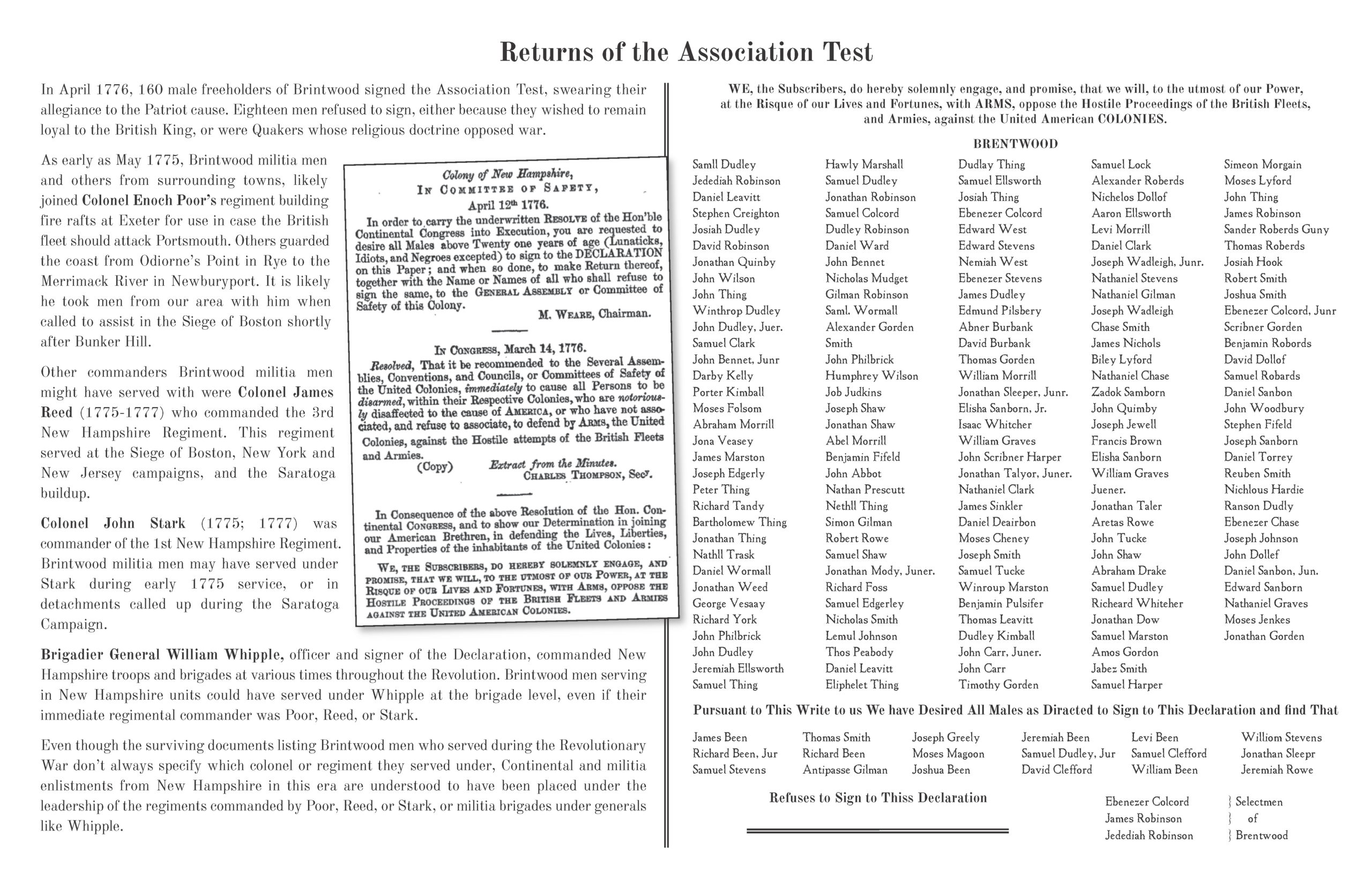
One of the most important documents for understanding this spiritual conflict is the New Hampshire Association Test.


On April 12, 1776 – nearly three months before the Declaration of Independence – New Hampshire’s Committee of Safety ordered local officials to obtain signatures from adult males on a declaration that stated in part:

“We, the Subscribers, do hereby solemnly engage, and promise, that we will, to the utmost of our Power, at the Risque of our Lives and Fortunes, with Arms, oppose the Hostile Proceedings of the British Fleets and Armies against the United American Colonies.”

Those who refused could be identified as potentially rebellious to the American cause and were subject to harassment and disarmament. The Test was, therefore, not merely a political statement, but an explicit pledge to support resistance by force of arms.


For many Quakers, signing posed a serious problem. While some Friends sympathized with colonial grievances, their religious principles generally prohibited pledging military service or participation in war. Across New Hampshire, a number of Quaker non-signers found themselves in this predicament.


Simply refusing to sign the military pledge did not indicate these individuals were Loyalists, or that they supported the British Crown, nor were they opposed to independence itself. Many Quakers throughout New England occupied a middle position – they opposed war on religious grounds while wishing to remain good neighbors and citizens.


There is strong evidence that this is true of the Brentwood non-signers as they remained influential members of the town –serving as Selectmen and in other municipal positions – showing the respect they held among their neighbors even though they did not actively serve in the military conflict.


Quakers in Brentwood


Brentwood’s Quaker population was significant during the eighteenth century, with Bean, Clifford, and Dudley names among town founders and the most prominent Quaker families.

The Association Test lists the following non-signers. Most are recognized Brentwood Quakers (*). The appearance of so many early founding family names on the list of non-signers strongly suggests their adherence to Quaker principles, rather than political opposition to independence. Their refusal reflected the difficulty many Friends faced when asked to pledge military action.

It should be noted that through early handwriting and later transcriptions, many family names were spelled in multiple ways. The “Beens” listed on the Association Test are an example of the different spellings.

James Been *                          William Been *                       Moses Magoon 

Richard Been *                       Samuel Clifford *                   Jeremiah Rowe

Richard Been jun *                 David Clifford *                     Jonathan Sleeper

Joshua Been *                         Samuel Dudley jun *             Thomas Smith

Jeremiah Been *                     Antipasse Gilman                   Samuel Stevens

Levi Been *                            Joseph Greeley                       William Stevens


Quakers and Revolutionary War Service

Although the Society of Friends officially opposed military participation, not every Quaker followed the discipline of the meeting. Throughout the colonies, some Friends served in militia units, paid military fines, hired substitutes, or otherwise actively supported the patriot cause.

Brentwood’s Quaker Meeting House and Cemetery

While Quaker meetings were informally occurring in individual homes prior to the founding of the town of Brentwood in 1742, it was not until 1751 that Brentwood Friends were given permission from the established Hampton Monthly Meeting to begin a preparative meeting under Hampton’s care. Complaints arose shortly thereafter in 1752 and continued through 1753 following accusations of “disorder” including: “two speaking at a time,” the wearing of clothing of the “wrong” color, “as to saluting each other men and women old and young pretending it to be a kiss of charity,” and to holding meetings at “unseasonable Friends’ days or nights.”


Ultimately, the Brentwood meeting never became a fully independent Monthly Meeting in the Quaker hierarchy. Instead, it remained a local meeting, calling itself the “Division Quakers” of Brentwood. This practice was consistent with other 18th-century Quaker dissolutions where worship persisted, but structure did not.


Sometime in the 1750s, a Quaker Meeting house was built on South Road in Brentwood to accommodate a growing participation, and along with it an accompanying burial ground.


A record exists within the text of the Proceedings of the John Bean (1660) Association: At its annual reunion at
Portland, Me. August 31, 1899
, page 146, stating: “By deed dated Feb’y 14, 1760, James Bean and James Dudley conveyed to the society called ‘Division Quakers’ an acre of land, on condition that the Quakers shall keep up their
meetings in Brentwood: it is probable that they did so, for in 1769, the deed was acknowledged and recorded.”


In the woods on the north side of South Road and near the entrance to Lake Road is a long abandoned burial ground, which in town history has been described as the Quaker Cemetery – because folks of that persuasion are buried there. And, while numerous Quaker practitioners lived in Brentwood, most would have been buried in their own family plots scattered around town.


In this cemetery, many stones are no longer legible, but in the records of the Brentwood Historical Society are noted some of the names of those resting there:


M. Bdye – Yey [sic] 1756 (the oldest stone yet found)


Elipha Dudley d. Oct 26, 1756 ae 13


James Dudley d. 1761 ae 47 yrs 4 ms


Another stone reads: “In memory of Dorothy wife of Capt. Thomas Gordon who d. Jan. 12, 1792 in the 46th yr of her age.” (She was Dorothy Gilman first wife of Capt. Thomas Gordon who is buried in the Gordon Cemetery on the opposite side of South Road.)


Sarah Abbot d. 1792 age 17, Jacob Smith, and Mary D. ae 3


Benjamin P. son of Peter and Mary Dudley d. Oct 2, 1803 ae 2 yrs 5 ms


Miss Jerusha Dudley d. Dec. 2, 1806 ae 22 yrs


Mr. Peter C. Dudley d. March 26, 1808 ae 47 yrs


Loammi Bean d. Aug. 26, 1823 ae 66 (daughter of Pastor James Bean)


Mr. Daniel Clifford d. Aug. 19, 1825 age 53


Mrs. Jemima Clifford w. of Mr. Daniel Clifford d. Oct 15, 1825 age 59


Miss Jane Page d. May 14, 1830 ae 22


Mrs. Mary wife of Peter C. Dudley d. Dec. 12, 1839 ae 72 yrs


Several other fieldstones and weathered stones simply read T.B., D.C., J.C., H.G., and Apphea, with no dates or further information about who these souls were.


By the early 1800s, gradually most remaining Brentwood Quakers had either taken up worship with the Hampton Monthly Meeting or moved to other New Hampshire or Massachusetts towns, some relocating as far away as California.

——–

In May of 2026, the Cemetery Trustees of Brentwood received official permission from the Hampton Monthly Meeting to begin a careful cleaning of this burial ground. As restoration begins, the Brentwood Cemetery Trustees and Brentwood Historical Society hope to build a better listing of the names of more souls who rest in this hallowed ground.

Page Views: 17